Well, I hit my body fat goal: 32% body fat.
That feels good to write, but the goal itself is only part of the story. The bigger story is what the biometrics say about the body I’ve been rebuilding, because the scale by itself would never explain this correctly.
Six years ago, on May 17, 2020, I was looking at weight loss very differently. I had already hit a goal once. In 2018 I got down to 245 pounds, then life got busy through 2019 and the start of 2020. By April of 2020, I was right back up to 298 pounds, so I started again.
At the time, I wrote something that still stands out to me:
I decided to make losing weight, maintaining a healthy weight, and regaining my strength and stamina a lifetime habit, and not just something to achieve.
Looking back at that now, I can see that the right idea was already there. I did not just want to be smaller. I wanted my strength back, my stamina back, and the feeling that I could move through life without my body fighting me every step of the way.
But back then, the scale was still the loudest thing in the room. I was thinking in terms of 298, 280, 245, and maybe 238 if I could get there without feeling bad. A couple of nutritionists and my doctor at the time had told me 238 was my ideal weight, but when I got close to that years earlier, I started having headaches and dizzy spells.
So even then, before I had better data, I knew something was off. At 6’8 3/4″, generic weight charts were never going to tell the whole story for me. They could give me a number, sure, but they could not tell me whether that number actually made sense for my frame, my muscle mass, my metabolism, or how I felt and performed.
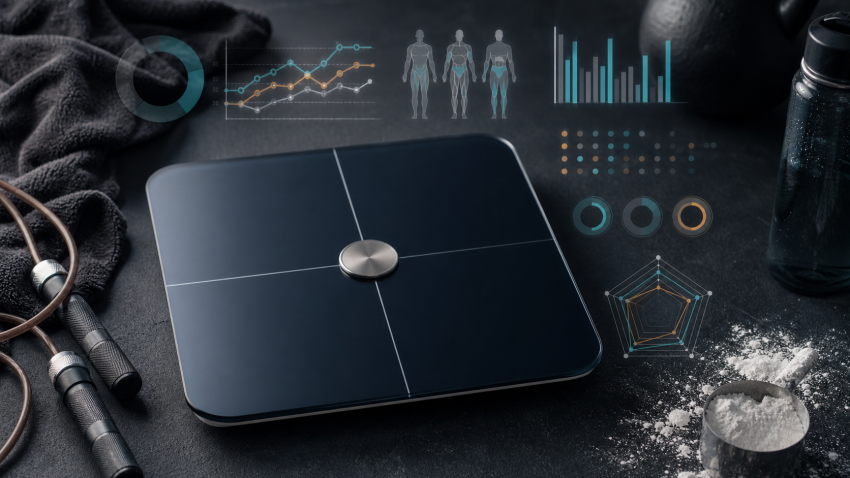
Now I have better measurements, and these are the current biometrics that changed how I look at the whole thing:
- Weight: 321.4 lb
- Skeletal muscle: 117.9 lb
- Fat mass: 102.9 lb
- Body water: 160.0 lb
- Body fat: 32.0%
- BMR: 2,510 calories
BMR stands for Basal Metabolic Rate. I’m 48 years old, and I’m 6’8 3/4″ tall.
That 32.0% body fat number is the goal I hit. And yes, I still have fat to lose. I’m not pretending otherwise. But this is where the numbers start telling a completely different story than the scale tells by itself.
By every reasonable standard, 117.9 pounds of skeletal muscle is impressive. That’s not just a nice bonus number on a scan. That’s the baseline of a powerful metabolic engine, and it’s a major reason my BMR is sitting at 2,510 calories.
By baseline, I mean that my body is already burning a lot of energy before I start working out. Before a 5K, before jump rope, before crawls, before carries, before hanging from a bar, before any deliberate training, my resting energy demand is already high. On a normal active day, my total daily burn can easily move into the 3,000 to 3,500 calorie range, which is why I have to think about this differently than someone who is simply trying to make the scale smaller as fast as possible.
The lean mass picture matters just as much. Out of 321.4 pounds, 102.9 pounds is fat mass. That means everything else is roughly 218.5 pounds of lean tissue: skeletal muscle, organs, bone, connective tissue, water, and all the structure that lets this body actually function.
That’s not something I want to wreck with reckless dieting. It’s something I want to protect.
This is the realization that changed the way I look at all of this, and it is also a big part of why I wrote The Untold Science of Weight Loss. I don’t just need to lose weight. I need to improve body composition, and there is a big difference between those two things.
If I only cared about the scale, I could cut calories hard, force the number down, and probably lose muscle along with the fat. I could end up lighter, but weaker, flatter, slower, and metabolically worse off. That’s not the goal.
The goal is to carry less fat on a body I want to keep strong.
That’s where BMI becomes almost absurd for someone built like me. If I plugged 321.4 pounds and 6’8 3/4″ into a BMI chart, it would call me obese and push the conversation in a completely different direction. It would treat the situation like a simple excess-weight problem, when the biometrics show something more specific.
The science says I still have too much body fat, but it also says I’m carrying a lot of lean mass, a high skeletal muscle load, and a strong metabolic output. So no, I’m not pretending 32% body fat is lean. It’s not. But I’m also not going to let a blunt population metric ignore the fact that this body is already athletic in several important ways.
That’s the nuance BMI misses. It can see weight and height, but it cannot see fat mass versus lean mass. It cannot see skeletal muscle. It cannot see BMR. It cannot see whether the next move should be a crash diet or a muscle-preserving cut.
For me, the next move is clear: sustain and cut.
That means maintain the muscle, cut the fat, and keep improving function. The next goal is 28% body fat. Going from 32% to 28% should put me somewhere around 300 to 305 pounds if I protect most of my lean mass, so I’m calling that roughly 18 to 20 pounds of fat loss.
That is very different from saying, “I need to lose 80 pounds because a chart said so.” I don’t need to chase a generic number. I need to move my body composition in the right direction while keeping the engine I’ve built.
So the plan is more full-body work: jump rope, crawls, carries, hangs, and possibly rock climbing or wall climbing. I like those movements because they do more than burn calories. They force my whole body to coordinate, stabilize, brace, grip, push, pull, and move as one system.
At my height, my core also has to become a bigger focus. My midsection already gets work from everything else I do. Running, jumping rope, crawling, carrying, hanging, and just moving a 321-pound body around all require core stability, but indirect work is not the same as direct development.
That’s the part I can feel right now. My arms, legs, back, shoulders, and conditioning are all moving, but my core feels like the one area that needs to catch up with the rest of the system. At 6’8 3/4″, my midsection has to support a very large frame, and the mechanical stress around my core is real.
For me, direct core work is not about chasing visible abs. It’s about structure. It’s about supporting my back, transferring force better, improving posture, moving more efficiently, and making the whole system more athletic.
So I’m going to give it more direct attention. That may mean more controlled core work, more anti-rotation work, more hangs and knee raise progressions, more crawling patterns, and possibly EMS for additional direct stimulation without adding more joint stress or spinal loading.
I don’t see EMS as a magic fat-loss tool. I see it as a support tool. My core already gets a lot of indirect stimulation from everything else I do, but EMS may be a smart way to add direct activation without beating up the rest of my body. That’s useful when the goal is to strengthen the weak link while still having enough energy to train, move, and recover.
So that’s where I am now. I hit 32% body fat, and BMI would still call me obese, but my biometrics tell me something more specific and more useful: I have fat left to cut, and I also have muscle, lean mass, and metabolic output worth protecting.
That’s the part I did not fully understand six years ago. Back then, I wanted to be a beast again. I still get that feeling, but I understand it differently now. It’s not about becoming the younger version of myself. It’s about becoming the smarter version.
The version that knows what to measure, what to cut, and just as important, what to keep.