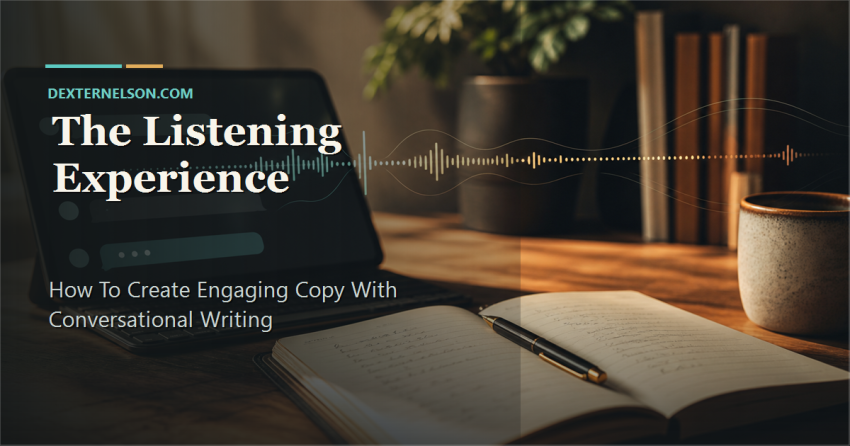
One of the best sales and copywriting strategies I can share is this: create a listening experience.
That phrase has been in my head for a long time. I started developing this conversational writing strategy back around 2011 or 2012, right at the beginning of my entrepreneurial journey, when I was learning sales, direct-response marketing, persuasion, and the uncomfortable difference between writing something that technically makes sense and writing copy people actually respond to.
At the time, I didn’t have the clean language for it that I have now. I just knew there was a difference between engaging copy that felt alive and copy that felt like words sitting on a page. Some emails, ads, sales pages, stories, and speeches could pull people in almost immediately, while others gave the reader every logical reason to care and still felt strangely cold.
Eventually, I realized the difference was not just the offer. It was the experience of being spoken to.
That’s where the listening experience comes in. The goal is to write in a way that makes the reader feel like they’re listening to someone talk directly to them. Not reading a pitch. Not scanning a corporate summary. Not being talked at by a brand. Listening to a real person guide them through an idea, a problem, a realization, and a possible solution. That is what makes conversational writing so powerful for sales copy, email marketing, and long-form content.
And yes, this is very much in the neighborhood of NLP, persuasion, and emotional communication. I don’t mean that in a manipulative way. I mean that words do not only transfer information. They create internal experiences, and that is the part a lot of writers miss.
Write The Way You Speak
The simplest way I explain the strategy is this: write the way you speak. Literally. That is the foundation of conversational copywriting.
Tone, pace, rhythm, emphasis, cadence, the little bridges between thoughts, the way you clarify something after you say it, the way you circle back when a point matters, all of that belongs to communication.
Most people don’t write that way, though. They write the way they think writing is supposed to sound, and that’s usually where the trouble starts. The human rhythm gets edited out. The sentence becomes polished, but the presence disappears.
Imagine somebody walking up to you and saying:
“In today’s rapidly evolving landscape, it is important to understand the significance of effective communication strategies.”
Nobody talks like that in real life. It may be technically correct, but it doesn’t feel like a person is there. It sounds like somebody swallowed a corporate memo and started reciting it out loud.
Real communication moves differently. It has rhythm, timing, pauses, emphasis, and small moments of reinforcement where the speaker makes sure you’re still with them. Good copy needs some of that because reader engagement is not only about the information. It’s about how the message feels while the person is reading it.
Logic Isn’t Enough
The reason this matters is that people don’t respond to writing as pure logic.
The way I used to explain it is that reading tends to come through the logical part of the brain, while decisions are driven much more deeply by emotion. You can call that the neocortex and the limbic system if you want the brain-language version, but the practical point is simple: something can make all the logical sense in the world and still not feel right.
Interesting word, right? Feel.
People say that all the time. “It makes sense, but it doesn’t feel right.” That sentence tells you almost everything you need to know about persuasion.
Logic can explain, justify, and organize the argument, but emotion moves the decision. So if your writing only appeals to logic, you may be giving the reader information without creating enough connection for them to care, trust, believe, or move.
That is why conversational writing matters. When you write the way you speak, something interesting happens. The reader stops processing the copy like a detached block of information and starts experiencing it more like a conversation. That is where emotional processing starts to wake up, and it is one of the reasons conversational copy can outperform stiff, overly polished marketing copy.
The Reader Has To Feel Spoken To
This is why some stories and books stay with you for your entire life. They don’t just tell you what happened. They connect with you. You remember the voice, the feeling, and the way the writer or speaker made you see something instead of merely understand it.
That same principle applies to sales copy, emails, content, teaching, speeches, and even social media posts. The format changes, but the human requirement underneath it doesn’t. People stay with communication when they feel like someone is actually there with them.
Before you write sales copy, put yourself mentally in a one-on-one conversation with one person. Not a market. Not an audience. One person.
That one shift changes the way you write because now you’re not trying to impress a crowd. You’re trying to reach a person. You’re thinking about what they already feel, what they’re frustrated by, what they want, what they’re afraid of, what they have tried, and what would make them feel seen instead of targeted.
That is where strong copy starts.
Cold Marketing Is Still A Conversation
This is especially important in cold marketing.
If you were standing in front of someone in person, you probably wouldn’t open with a polished paragraph about your company’s innovative solution. You would introduce yourself. You would pay attention. You would listen for the pain point, the problem, the frustration, or the thing they’re trying to get done.
Then, if you had a real solution, you might say something as simple as:
“Hey, I can help you with that.”
That is the basic shape of good sales communication.
The only difference in cold email, ads, or written copy is that you don’t get to ask the questions in real time, so you do the work before you write. You study the pain points, the problems, what they want, what they’re looking for, what they have already tried, and what would make the offer feel relevant.
Then you talk to them.
That part matters. You are not writing for an audience. You are talking to one person. You want them to have a listening experience when they read your email, your post, or your sales page. You want them to feel like you are talking to them specifically.
You’ve probably had that experience before. You hear a speaker, read a message, listen to a sermon, watch a video, or read a book and think, “It felt like they were talking directly to me.” That’s not an accident. That’s connection, and if you’re writing copy, that is what you want to duplicate.
Why So Much Copy Feels Flat
A lot of modern writing feels emotionally flat because it is optimized for presentation instead of communication. It may be structured, polished, grammatically correct, and even full of useful information, but it still doesn’t feel human.
That usually happens when the writer strips out the exact things that make spoken communication work: pacing variation, conversational bridges, emotional timing, thought progression, reinforcement, analogy, and rhythm. Those are the details that help copywriting feel human instead of processed.
Instead of one thought naturally moving into the next, the writing becomes a stack of disconnected statements.
You see this kind of thing everywhere:
“This matters. Businesses should pay attention. Consumers are changing. Markets are evolving.”
Nothing there is technically wrong, but it doesn’t sound like somebody talking. It sounds like bullet points pretending to be prose.
Now compare that to this:
“This matters because consumers are changing how they make decisions, and businesses that ignore that shift are eventually going to feel it.”
Same basic idea, but a different experience. One sounds like a presentation. The other sounds like communication, and people respond to communication.
Punctuation Is Part Of The Voice
This is another thing people underestimate: punctuation isn’t just grammar. It’s pacing.
Commas create micro-pauses. Paragraph breaks reset cadence. Sentence length controls tempo. A short sentence can hit hard when it shows up at the right moment, but if every sentence is chopped into its own dramatic little line, the writing starts to feel staged.
Good conversational writing has movement. Sometimes it slows down. Sometimes it speeds up. Sometimes it presses on a word. Sometimes it lets a longer sentence carry the reader through a connected thought because that’s how people actually talk when they’re explaining something they understand.
That’s why “write like you speak” does not mean “write carelessly.” It means pay attention to how real communication works, then shape the writing so it preserves that human rhythm.
The Real Goal Is Emotional Continuity
Most people think engaging copy is about hype, hooks, or constantly trying to stimulate the reader. Sometimes a strong hook helps, but that is not usually what keeps someone with you.
What keeps people reading is emotional continuity. The next sentence feels like it belongs after the one before it. The idea keeps moving. The tone stays relational. The reader doesn’t feel like they’re being yanked from point to point. They feel guided.
That is why conversational writing works so well in sales, storytelling, teaching, speeches, podcasting, long-form articles, social media posts, and email marketing. The medium changes, but the human need is the same.
People stay engaged when communication feels relational instead of transactional.
And honestly, I think this is part of why so much AI-generated writing still feels slightly off even when it is technically impressive. It can organize information extremely well, but presence is harder.
Presence is the part where the reader feels like somebody is actually there.
The Listening Experience
At the end of the day, the best writing usually doesn’t feel like writing at all. It feels like someone explaining something to you, guiding you through a thought, and seeing the problem clearly enough to say, “Hey, I can help you with that.”
That is the listening experience.
Once you understand that, you stop writing only to deliver information and start writing to create connection. You still care about clarity, structure, and usefulness, but you also care about rhythm, emotional movement, and whether the words feel like they came from a real person talking to another real person.
That is when people stop skimming and start listening.